
The Objectives of Lighting
On the first day of a film shoot, why would a crew deliberately “ruin” perfect natural light, only to recreate it from scratch? In this episode of Visium, we unpack what lighting is really for beyond “mood,” tracing it to its most fundamental objectives. This episode takes you onto the set, revealing the practical workflow that helps directors and crews stay efficient under pressure, and why a few early decisions can shape an entire filming day.
This is a transcript from Visium: The Secret Language of Images. Listen to the episode below:
Let’s say that it’s the first day of filming your first feature film. It’s a romantic comedy, and you arrive at the location early. The sun comes in beautifully through the window, exactly like you had imagined it. Everything seems perfect.
Suddenly, you hear the unmistakable beeping sound of a truck backing up. The crew has arrived. And what’s the first they are going to do? Block that beautiful sunlight using large frames with black fabric, and spend a lot of time, with very expensive equipment, to recreate it with lighting. That doesn’t make any sense, does it?
I’m Tal Lazar, and this is Visium—where we explore images and figure out what makes them work. In this first series, we’re focusing on the images you see in movies.
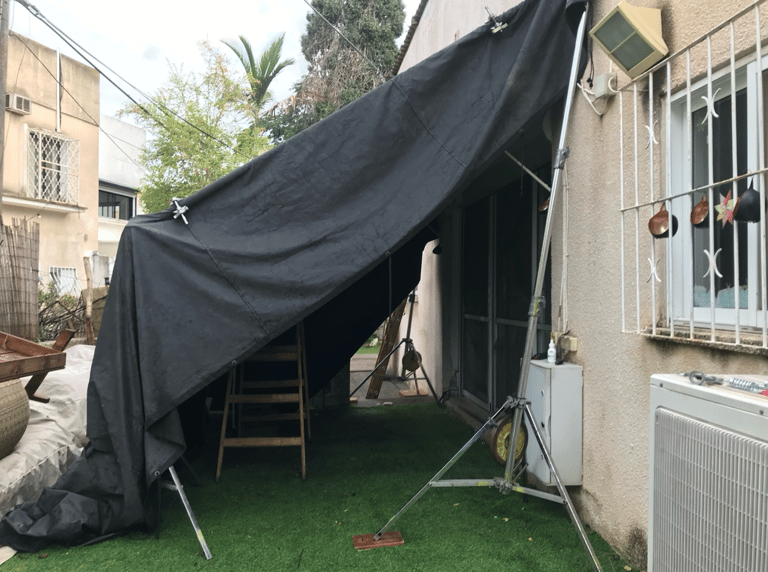
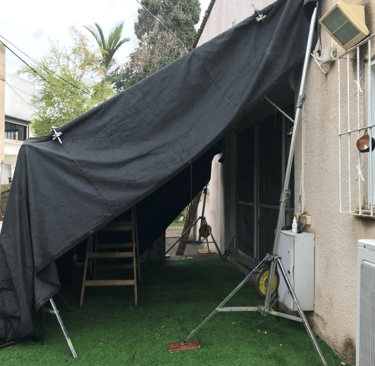
Grip equipment blocking natural light
So why does the crew ruin a perfect naturally lit scene just to recreate it using lighting? Is it a union thing? Not at all. One of the big problems with relying on natural light is consistency. You might like the light the way it is when you arrive on set, but by the time the actors are out of makeup and wardrobe, the light will be different. Even a scene that only takes a couple of minutes on screen can take many hours to shoot. During that time, the sun moves. Clouds come in and out. If you want your shots to fit together in the final edit, then the lighting needs to look somewhat similar between all the shots.
I often ask students, why light at all? Why take the effort? It takes so many people, the equipment is expensive, it slows things down… why not just shoot it the way it is? The first answer is usually about tone or atmosphere. But the truth is that there are more urgent reasons to use lighting in scenes. Let’s dive in to the objectives of lighting.
The first, and most basic reason to use lighting is: visibility. Or in camera terms, exposure. It’s a purely technical goal. Cameras need a minimum amount of light to expose an image, and in some scenes we need to create that artificially. Even if it was possible to use the moon for lighting in a night scene, one cloud would change everything. Movies are too expensive to make to rely on luck, and besides the moon is not enough anyway. Lighting allows us to give the camera enough light to expose an image, and decide what’s visible, and what’s not in any other scene.
The second objective is believability. We explored realism in the last two episodes, and lighting has a big part in building a believable fictional world. Modern lighting conventions demand that lighting has a reason to be there, so it’s always tied to something realistic in the world of the movie. A night scene might be lit by the moon, or a flashlight, or car headlights for example. It is possible to light for a scene to appear as if it’s completely dark but it must still be believable. Believability is not only about intensity of light, but also about proportion. For example, let’s say that you have an interior night scene. A table lamp is on, and the moon comes in gently from the window. It would not be believable for the moon light to be brighter than the table lamp, right? To maintain believability, lighting designers need to keep the intensity of light proportional, so the audience is not distracted.
The third objective of lighting is emphasis. We already talked about emphasis in images, using contrast and color. But color and contrast can be created with lighting, so this becomes an important function here. With lighting we can direct the viewers eyes and make them pay attention to details, hint at what’s important. Or hide something in plain sight.
The fourth objective of lighting is delivery of information. Cinematographers spend a lot of time training for this, designing lighting for an interior day setting in a studio, for example, making the audience believe the time of day. Delivery of information is all about building fictional worlds with lighting. There’s a great scene I often use from No Country for Old Men, where the hero lies in bed in a cheap motel. I ask students to guess what floor he’s on, and no one ever thinks he’s on the ground floor. That has a lot to do with the light of a streetlamp coming through a window. When the hero suspects someone is walking in the hallway and bends down to listen through the crack under the door, I ask students to describe the hallway, even though we can’t see it at all - just a bit of light coming in through the crack. Yet, everyone tends to describe a fluorescent lit hallway. You see, lighting can do so much with so little. But to achieve this, the lighting designer needs to be really good at what we worked on two episodes ago: observation, and communication. How does light coming through a streetlamp look like on the second floor of a nearby motel? How does a dingy hallway, lit by fluorescents, feel from a crack under a door? Cinematographers and lighting designers look at light all the time to figure stuff like this out. And when the time comes, they use this information to extend the set way beyond the confinements of the frame.
The fifth objective of lighting is separation and depth. Remember space, the visual design element? Our canvas is two dimensional, and we can if we want make it feel three dimensional using depth cues. Lighting plays a big part in that. The way lighting creates depth is by using shadows. When a subject is lit from the angle of the camera, so that the shadows are thrown away and are basically invisible to the camera, we call that flat lighting because it diminishes the sense of depth. And when we light from the side, so that shadows are created, it starts feeling like there’s depth.
Space is also emphasized by lighting the foreground and background separately. Lighting designers often think like painters, using techniques like chiaroscuro, which originated in Italy during the Renaissance. Look it up and you’ll see things like a face lit from the side, the bright side contrasting against a dark background, while the dark side of the face contrasting against a brighter background. Alternating darkness and brightness is what chiaroscuro is, and it creates separation and depth.
The sixth objective of lighting is where students usually begin, that’s tone and atmosphere. We do want sometimes for lighting to create a mood, especially when the scene is governed by a specific genre. A simple dialogue scene might be lit entirely different in a romantic comedy compared to a horror film, right?
And finally, the last objective of lighting is to create effects that can otherwise not be created. For example, you might use lighting to emulate firelight when it’s not possible to light an actual fire, or create the effects of a lightning strike since waiting for a real one is impossible. An effect created by lighting that I especially like is called the Poor man’s process, where lighting is used to make it appear like a car is moving, even though it’s not moving at all. Filmmakers do it when moving a car is impossible, it often requires closing streets or getting special equipment that’s very expensive. The alternative is to put the car in a studio or a parking lot and use moving lights to make it appear like the car is moving. Many movies do this, and sometimes you can’t even tell the difference.
Visibility
Believability
Emphasis
Delivery of information
Separation and depth
Tone and atmosphere
Creating effects
These are the objectives of lighting. When thinking of lighting a scene, it helps to first start by looking at how these objectives can help telling the story. What should be visible, and what should be hidden? What information can be delivered with lighting? Is depth a design element that’s used in the scene? What is the general tone? Of course, visual references should be an important part of this process.
There’s no reason a director cannot be part of this conversation, and even lead it. There’s nothing technical about this, and there’s a lot of room for creativity after these objectives have been determined.
OK, so let’s say we did all that, and now we’re on set. How does lighting actually happen when the director and actors are around? There’s a specific way that has been developed over the many years of filmmaking that works pretty well. It’s a framework you might be familiar with: block, light, rehearse, shoot. On set, efficiency and time management are very important. There isn’t a minute to spare, and if you want you can actually calculate how much a single minute on set costs. We did this once and let’s just say it didn’t help with the stress.
When it comes to lighting, one of the most important and crucial technical decisions is deciding which lamp to use for a specific function. That’s because once that decision is made, it’s very difficult to undo. I allowed myself one time, only a single time for an entire feature film, to go to the assistant director when the actors are already on set, and tell them - listen I made a mistake and need to change the lighting. Because to make a big change, the first team, that’s the actors and director, have to leave the set so that the crew can come in with sandbags, stands and sometimes ladders. A good assistant director would not let the crew bring in heavy gear while the actors are on set for safety reasons.
So to avoid this situation and save valuable time, it’s important to follow the framework. First, block. Imagine that you arrive in the morning to set. The first thing is not to send the actors to makeup, actually. It’s usually a safety meeting to announce anything special and make the crew aware of it, and then the director takes the actors to do a quick rehearsal. When they are ready, the assistant director calls in the department heads, like the gaffer, sound recordist and 1st AC, to watch a blocking rehearsal. We’ll talk more about blocking later on, but essentially the crew gets to see where the actors are going to stand and move in a scene. The idea is that they are generally going to do the same thing later. How much flexibility there is, well that’s up to the director but it should be discussed in pre-production. The more flexible the blocking, the less possible it is to create accurate lighting based on positioning. There’s nothing wrong with that, it’s just a matter of style. That’s why it should be agreed upon in pre-production. If it’s not discussed, it can become a point of conflict on set.
A second assistant camera person usually marks actor’s positions using tape or special markers, and then the actors leave for their makeup and wardrobe. That gives the crew time to work, and it all happens simultaneously saving time. After blocking comes lighting. That’s when the crew brings in lamps and makes it all safe. Sometimes there’s a second team, that’s stand-ins who also watch the blocking rehearsal and stand in for the actors when they leave for makeup and wardrobe. Some Hollywood actors have regular stand-ins that look exactly like them, making it even easier to prepare lighting that works without surprises later on.
When lighting is done and actors are ready, they step back on set for another rehearsal. This is with or without the camera, depending on how the set is run. But eventually there is a camera rehearsal, and then filming. When the shot is done, actors step off set for the crew to change the lighting, and we go again. When the scene is over, the next one is blocked.
Now, in theory, this works pretty well. But in practice there are a few adjustments to make. First of all, block, light, rehearse, shoot assumes that the director has already rehearsed with the actors beforehand. A blocking rehearsal is just a walkthrough, really just for positioning. I’ve had many instances where we did a blocking rehearsal and it was obvious that the actors are not yet familiar with the scene. In such cases I usually call the director and assistant director for a quick huddle. If the scene is not finalized in the actors and director’s minds, then it will be difficult for them to repeat the same thing later on. Better ideas will come, or they will simply forget things they did, and that will cause delays. Again, this very much depends on the style of work on set which should be discussed beforehand.
From the crew’s perspective, it’s actually very rare that the crew needs to wait for a blocking rehearsal to start working. Somethings are already know in advance. On a soundstage, when we use a three wall set, it’s pretty obvious where the camera is never going to be looking at and this allows the crew to set up gear and power lines. We always try to pre-light as much as possible to save time, and this is based on conversations with the director in pre-production.
And finally, somewhere between the last rehearsal and shooting there is tweaking of lighting. Because a blocking rehearsal is fine for rough lighting, but fine adjustments must be made with the actors on set. Tweaking is not the same thing as lighting. Tweaking is panning or tilting a light, moving a diffusion frame a bit, or changing a gel. It can be done quietly and fast, and it usually does not involve bringing in heavy equipment into the set. That’s something the crew continuously does, even between takes, as the cinematographer keeps improving the scene.
This should give you a solid theoretical background to start designing lighting, or rethink your existing process when you are collaborating on set. Our next stop is to go a bit wide and look at the collaboration between the cinematographer and the director. How are cinematographers hired? How do they work together in pre-production and on set, specifically blocking a scene?
If this sounds interesting, make sure to subscribe, leave a review, and join me next time as we keep exploring how filmmakers bring images—and stories—to life. If you have any thought, an example that wasn’t mentioned or a question, feel free to reach out—just email tal@cinematicimpact.com . You can also check out my book at TheLanguageofCinematography.com.
Thanks for spending time with me today. Goodbye!
Why light at all? Why take the effort? It takes so many people, the equipment is expensive, it slows things down… why not just shoot it the way it is?
This is a transcript from Visium: The Secret Language of Images. Listen to the episode below:
Let’s say that it’s the first day of filming your first feature film. It’s a romantic comedy, and you arrive at the location early. The sun comes in beautifully through the window, exactly like you had imagined it. Everything seems perfect.
Suddenly, you hear the unmistakable beeping sound of a truck backing up. The crew has arrived. And what’s the first they are going to do? Block that beautiful sunlight using large frames with black fabric, and spend a lot of time, with very expensive equipment, to recreate it with lighting. That doesn’t make any sense, does it?
I’m Tal Lazar, and this is Visium—where we explore images and figure out what makes them work. In this first series, we’re focusing on the images you see in movies.
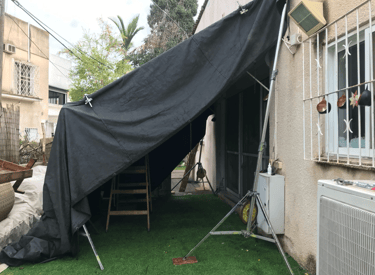
Grip equipment blocking natural light
So why does the crew ruin a perfect naturally lit scene just to recreate it using lighting? Is it a union thing? Not at all. One of the big problems with relying on natural light is consistency. You might like the light the way it is when you arrive on set, but by the time the actors are out of makeup and wardrobe, the light will be different. Even a scene that only takes a couple of minutes on screen can take many hours to shoot. During that time, the sun moves. Clouds come in and out. If you want your shots to fit together in the final edit, then the lighting needs to look somewhat similar between all the shots.
I often ask students, why light at all? Why take the effort? It takes so many people, the equipment is expensive, it slows things down… why not just shoot it the way it is? The first answer is usually about tone or atmosphere. But the truth is that there are more urgent reasons to use lighting in scenes. Let’s dive in to the objectives of lighting.
The first, and most basic reason to use lighting is: visibility. Or in camera terms, exposure. It’s a purely technical goal. Cameras need a minimum amount of light to expose an image, and in some scenes we need to create that artificially. Even if it was possible to use the moon for lighting in a night scene, one cloud would change everything. Movies are too expensive to make to rely on luck, and besides the moon is not enough anyway. Lighting allows us to give the camera enough light to expose an image, and decide what’s visible, and what’s not in any other scene.
The second objective is believability. We explored realism in the last two episodes, and lighting has a big part in building a believable fictional world. Modern lighting conventions demand that lighting has a reason to be there, so it’s always tied to something realistic in the world of the movie. A night scene might be lit by the moon, or a flashlight, or car headlights for example. It is possible to light for a scene to appear as if it’s completely dark but it must still be believable. Believability is not only about intensity of light, but also about proportion. For example, let’s say that you have an interior night scene. A table lamp is on, and the moon comes in gently from the window. It would not be believable for the moon light to be brighter than the table lamp, right? To maintain believability, lighting designers need to keep the intensity of light proportional, so the audience is not distracted.
The third objective of lighting is emphasis. We already talked about emphasis in images, using contrast and color. But color and contrast can be created with lighting, so this becomes an important function here. With lighting we can direct the viewers eyes and make them pay attention to details, hint at what’s important. Or hide something in plain sight.
The fourth objective of lighting is delivery of information. Cinematographers spend a lot of time training for this, designing lighting for an interior day setting in a studio, for example, making the audience believe the time of day. Delivery of information is all about building fictional worlds with lighting. There’s a great scene I often use from No Country for Old Men, where the hero lies in bed in a cheap motel. I ask students to guess what floor he’s on, and no one ever thinks he’s on the ground floor. That has a lot to do with the light of a streetlamp coming through a window. When the hero suspects someone is walking in the hallway and bends down to listen through the crack under the door, I ask students to describe the hallway, even though we can’t see it at all - just a bit of light coming in through the crack. Yet, everyone tends to describe a fluorescent lit hallway. You see, lighting can do so much with so little. But to achieve this, the lighting designer needs to be really good at what we worked on two episodes ago: observation, and communication. How does light coming through a streetlamp look like on the second floor of a nearby motel? How does a dingy hallway, lit by fluorescents, feel from a crack under a door? Cinematographers and lighting designers look at light all the time to figure stuff like this out. And when the time comes, they use this information to extend the set way beyond the confinements of the frame.
The fifth objective of lighting is separation and depth. Remember space, the visual design element? Our canvas is two dimensional, and we can if we want make it feel three dimensional using depth cues. Lighting plays a big part in that. The way lighting creates depth is by using shadows. When a subject is lit from the angle of the camera, so that the shadows are thrown away and are basically invisible to the camera, we call that flat lighting because it diminishes the sense of depth. And when we light from the side, so that shadows are created, it starts feeling like there’s depth.
Space is also emphasized by lighting the foreground and background separately. Lighting designers often think like painters, using techniques like chiaroscuro, which originated in Italy during the Renaissance. Look it up and you’ll see things like a face lit from the side, the bright side contrasting against a dark background, while the dark side of the face contrasting against a brighter background. Alternating darkness and brightness is what chiaroscuro is, and it creates separation and depth.
The sixth objective of lighting is where students usually begin, that’s tone and atmosphere. We do want sometimes for lighting to create a mood, especially when the scene is governed by a specific genre. A simple dialogue scene might be lit entirely different in a romantic comedy compared to a horror film, right?
And finally, the last objective of lighting is to create effects that can otherwise not be created. For example, you might use lighting to emulate firelight when it’s not possible to light an actual fire, or create the effects of a lightning strike since waiting for a real one is impossible. An effect created by lighting that I especially like is called the Poor man’s process, where lighting is used to make it appear like a car is moving, even though it’s not moving at all. Filmmakers do it when moving a car is impossible, it often requires closing streets or getting special equipment that’s very expensive. The alternative is to put the car in a studio or a parking lot and use moving lights to make it appear like the car is moving. Many movies do this, and sometimes you can’t even tell the difference.
Visibility
Believability
Emphasis
Delivery of information
Separation and depth
Tone and atmosphere
Creating effects
These are the objectives of lighting. When thinking of lighting a scene, it helps to first start by looking at how these objectives can help telling the story. What should be visible, and what should be hidden? What information can be delivered with lighting? Is depth a design element that’s used in the scene? What is the general tone? Of course, visual references should be an important part of this process.
There’s no reason a director cannot be part of this conversation, and even lead it. There’s nothing technical about this, and there’s a lot of room for creativity after these objectives have been determined.
OK, so let’s say we did all that, and now we’re on set. How does lighting actually happen when the director and actors are around? There’s a specific way that has been developed over the many years of filmmaking that works pretty well. It’s a framework you might be familiar with: block, light, rehearse, shoot. On set, efficiency and time management are very important. There isn’t a minute to spare, and if you want you can actually calculate how much a single minute on set costs. We did this once and let’s just say it didn’t help with the stress.
When it comes to lighting, one of the most important and crucial technical decisions is deciding which lamp to use for a specific function. That’s because once that decision is made, it’s very difficult to undo. I allowed myself one time, only a single time for an entire feature film, to go to the assistant director when the actors are already on set, and tell them - listen I made a mistake and need to change the lighting. Because to make a big change, the first team, that’s the actors and director, have to leave the set so that the crew can come in with sandbags, stands and sometimes ladders. A good assistant director would not let the crew bring in heavy gear while the actors are on set for safety reasons.
So to avoid this situation and save valuable time, it’s important to follow the framework. First, block. Imagine that you arrive in the morning to set. The first thing is not to send the actors to makeup, actually. It’s usually a safety meeting to announce anything special and make the crew aware of it, and then the director takes the actors to do a quick rehearsal. When they are ready, the assistant director calls in the department heads, like the gaffer, sound recordist and 1st AC, to watch a blocking rehearsal. We’ll talk more about blocking later on, but essentially the crew gets to see where the actors are going to stand and move in a scene. The idea is that they are generally going to do the same thing later. How much flexibility there is, well that’s up to the director but it should be discussed in pre-production. The more flexible the blocking, the less possible it is to create accurate lighting based on positioning. There’s nothing wrong with that, it’s just a matter of style. That’s why it should be agreed upon in pre-production. If it’s not discussed, it can become a point of conflict on set.
A second assistant camera person usually marks actor’s positions using tape or special markers, and then the actors leave for their makeup and wardrobe. That gives the crew time to work, and it all happens simultaneously saving time. After blocking comes lighting. That’s when the crew brings in lamps and makes it all safe. Sometimes there’s a second team, that’s stand-ins who also watch the blocking rehearsal and stand in for the actors when they leave for makeup and wardrobe. Some Hollywood actors have regular stand-ins that look exactly like them, making it even easier to prepare lighting that works without surprises later on.
When lighting is done and actors are ready, they step back on set for another rehearsal. This is with or without the camera, depending on how the set is run. But eventually there is a camera rehearsal, and then filming. When the shot is done, actors step off set for the crew to change the lighting, and we go again. When the scene is over, the next one is blocked.
Now, in theory, this works pretty well. But in practice there are a few adjustments to make. First of all, block, light, rehearse, shoot assumes that the director has already rehearsed with the actors beforehand. A blocking rehearsal is just a walkthrough, really just for positioning. I’ve had many instances where we did a blocking rehearsal and it was obvious that the actors are not yet familiar with the scene. In such cases I usually call the director and assistant director for a quick huddle. If the scene is not finalized in the actors and director’s minds, then it will be difficult for them to repeat the same thing later on. Better ideas will come, or they will simply forget things they did, and that will cause delays. Again, this very much depends on the style of work on set which should be discussed beforehand.
From the crew’s perspective, it’s actually very rare that the crew needs to wait for a blocking rehearsal to start working. Somethings are already know in advance. On a soundstage, when we use a three wall set, it’s pretty obvious where the camera is never going to be looking at and this allows the crew to set up gear and power lines. We always try to pre-light as much as possible to save time, and this is based on conversations with the director in pre-production.
And finally, somewhere between the last rehearsal and shooting there is tweaking of lighting. Because a blocking rehearsal is fine for rough lighting, but fine adjustments must be made with the actors on set. Tweaking is not the same thing as lighting. Tweaking is panning or tilting a light, moving a diffusion frame a bit, or changing a gel. It can be done quietly and fast, and it usually does not involve bringing in heavy equipment into the set. That’s something the crew continuously does, even between takes, as the cinematographer keeps improving the scene.
This should give you a solid theoretical background to start designing lighting, or rethink your existing process when you are collaborating on set. Our next stop is to go a bit wide and look at the collaboration between the cinematographer and the director. How are cinematographers hired? How do they work together in pre-production and on set, specifically blocking a scene?
If this sounds interesting, make sure to subscribe, leave a review, and join me next time as we keep exploring how filmmakers bring images—and stories—to life. If you have any thought, an example that wasn’t mentioned or a question, feel free to reach out—just email tal@cinematicimpact.com . You can also check out my book at TheLanguageofCinematography.com.
Thanks for spending time with me today. Goodbye!
Why light at all? Why take the effort? It takes so many people, the equipment is expensive, it slows things down… why not just shoot it the way it is?